Most trip money arguments come from vague agreements and late maths. Settle the rules before you leave, record each cost the day it happens, and the end of the trip takes five minutes.
Updated November 12, 2026 · General information, not financial advice.
Before the trip: agree on what is shared
Shared by everyone: accommodation, car rental, fuel, groceries for the place.
Shared by whoever joins: dinners, tours and tickets.
Personal: souvenirs, solo coffees, anything only one person wanted.
Also decide who books the big items and how you will pay each other back at the end.
During the trip: record each cost the same day
For every shared expense, note three things: the amount, who paid and who it was for. Do it the same day while the receipt is in hand. Waiting until the drive home is how costs go missing.
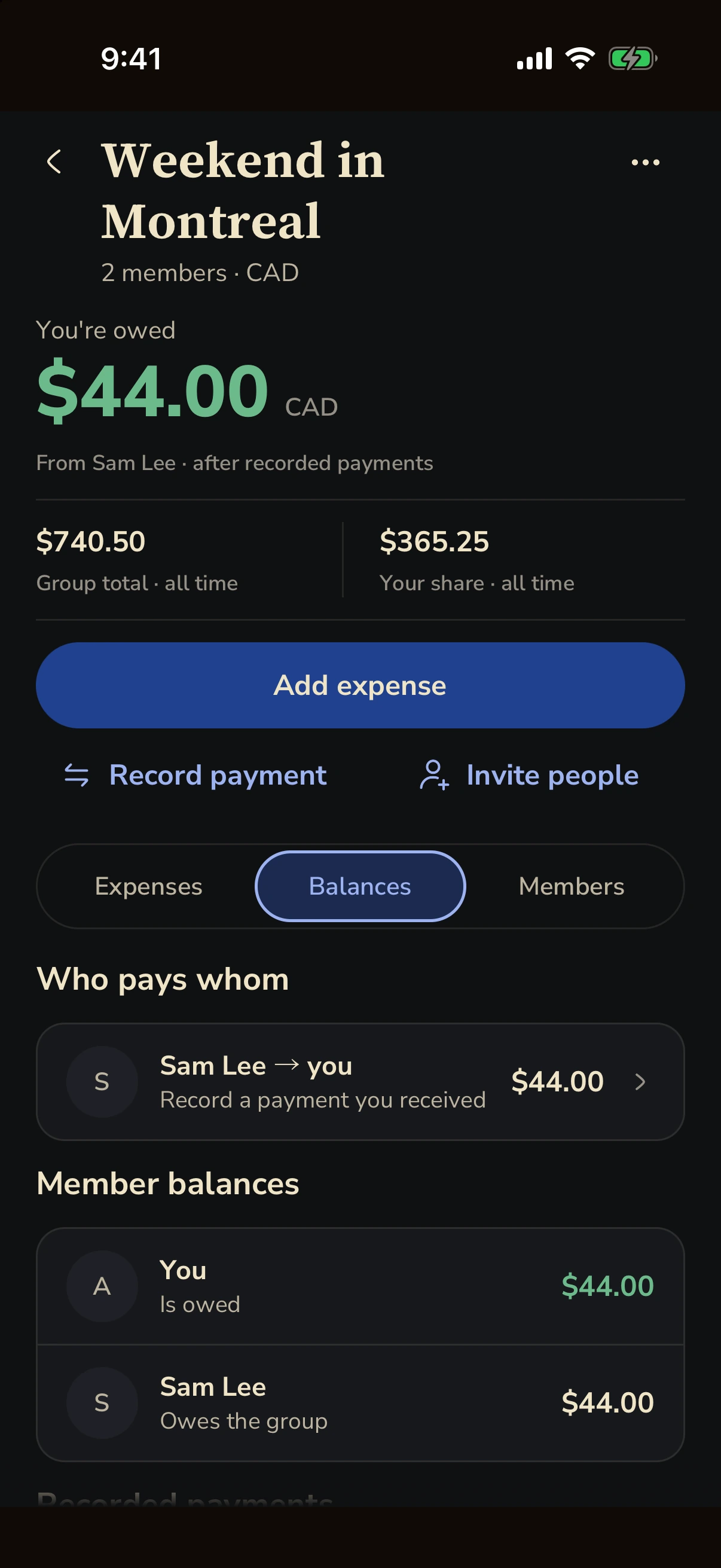
In Fin, create a group for the trip, add each expense and see who owes what as you go.
Real Fin screenshot · synthetic demo data
Worked example: a weekend in Montreal
Alex, Sam and Maya share a weekend. Three costs, each paid by a different person:
Montreal weekend expenses
Expense
Paid by
Amount
Split
Hotel
Alex
CA$420
Everyone
Dinner
Sam
CA$168
Everyone
Groceries
Maya
CA$90
Everyone
The total is CA$678, so each person's equal share is CA$226. Each balance is what they paid minus their share:
Alex paid CA$420, so is owed CA$194.
Sam paid CA$168, so owes CA$58.
Maya paid CA$90, so owes CA$136.
Settle in two payments
Sam pays Alex CA$58. Maya pays Alex CA$136. Everyone is even.
When someone skips part of the trip
Say Maya skipped dinner. Split dinner between Alex and Sam only (CA$84 each) and keep the rest equal. Shares become Alex CA$254, Sam CA$254 and Maya CA$170. Now Sam pays Alex CA$86 and Maya pays Alex CA$80. The trip total is still CA$678.
Settle up with the fewest payments
Pay each other back from balances, not expense by expense. Whoever is owed the most receives first. In a small group, that usually means one payment from each person who owes. Send the money however you normally do, for example by Interac e-Transfer, then record the payment so the balance clears.
Recording a payment in Fin updates the group's balances. Fin keeps the record; it does not send or hold money.
Tips that save arguments
Keep one currency per trip. Abroad, agree on which currency the group uses and convert once when you settle.
Round only at the end. Rounding every expense adds up to real money over a long trip.
Settle within a week. Balances are easiest to agree on while the trip is fresh.

 Get for iPhone